Family Expectations and Mental Health: The Hidden Pressure Facing Kenyan Youth

Photo: AI-generated for illustration purposes.
Behind every good grade, graduation gown and job application is a young person trying to live up to the hopes of those who love them.
For many young people in Kenya, family expectations can be a source of motivation— but they can also bring emotional pressure. Through the experiences of a university student, a recent graduate and a youth mentor, this feature explores how the desire to make loved ones proud can affect mental well-being and why supportive family relationships matter.
Sarah (not her real name) pauses for a moment before answering a question that seems simple but carries a great deal of weight: “What do your parents expect from you? “ she lowers her eyes briefly and smiles faintly. Her father, an engineer, had always hoped she would follow in his footsteps. Instead, she chose Journalism, a course she says she genuinely love.
Purity Achieng (not her real name) refreshes another job advertisement on her phone, hoping today will finally bring good news. Their lives are different, yet they share one silent burden—the pressure to meet their families’ expectations.
For many young people, parents’ expectations are born out of love, sacrifice and hope for a better future. Families invest heavily in education, believing it will open doors to success. However, when those expectations become overwhelming, they can leave young people struggling with stress, self-doubt and emotional exhaustion.
This feature explores how family expectations shape the mental well-being of young people through the experiences of a university student, a recent graduate and a youth mentor, while drawing on research that highlights the growing importance of mental health among adolescents and young adults.
Sarah, a Journalism student at KCA University, says she has always wanted to make her parents proud. Growing up, academic excellence was highly valued in her family, and she worked hard to achieve good grades. However, choosing Journalism instead of Engineering created an emotional conflict between pursuing her passion and fulfilling her father’s dream.
“My dad wanted me to become an engineer like him, but I chose Journalism,” she says. “Sometimes I worry that I will disappoint him because he expected something different.”
Although she enjoys her course, Sarah admits that the pressure to excel academically while trying to satisfy family expectations often becomes emotionally draining.
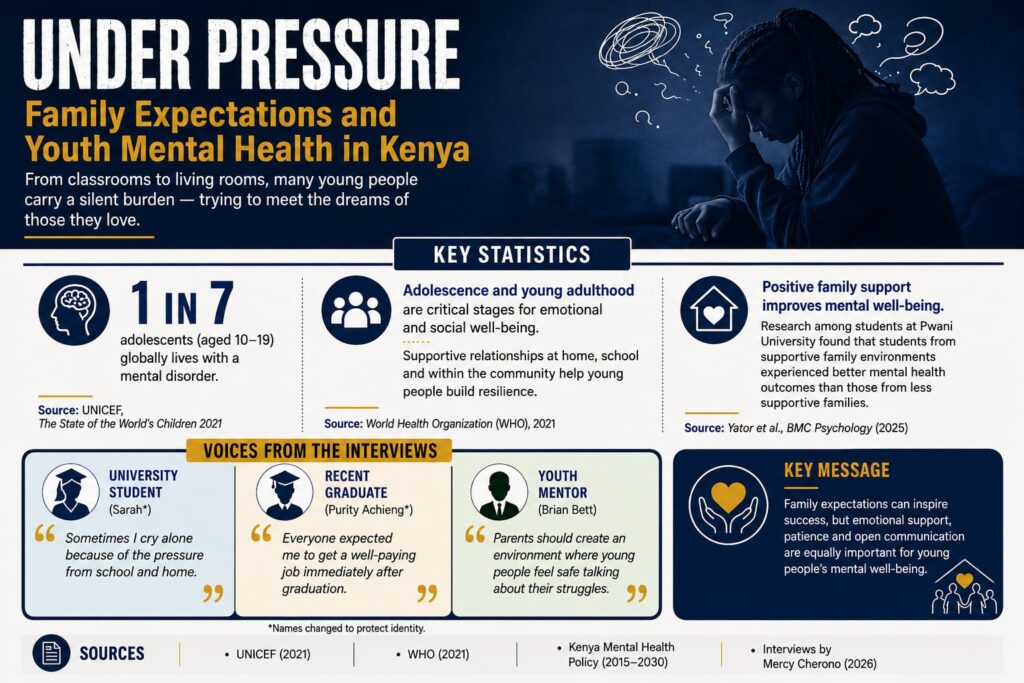
“Campus life is not easy, Sometimes I cry alone because of the pressure from school and home,”she explains.
She says mental health is rarely discussed openly in her family, making it difficult to express how she truly feels.
“I mostly talk to my mum when I feel overwhelmed, but we don’t really discuss mental health as a family,” she says.
Sarah believes many parents focus on academic performance without realizing the emotional challenges students experience behind the scenes.
Her experience is not unique.
According to UNICEF’s State of the World’s Children 2021: On My Mind, one in seven adolescents aged 10–19 years globally lives with a mental disorder.
For Purity Achieng, the pressure intensified after graduation.
Like many university graduates, she believed earning a degree would open doors to employment. Instead, she found herself facing months of job applications, unanswered emails and growing expectations from home.
“Everyone expected me to get a well-paying job immediately after graduation,” she recalls. “They believed things would change quickly once I had my degree.”
Purity says the transition from university to the job market was far more difficult than she had imagined. While she remained hopeful and continued applying for jobs, some family members assumed that graduating meant she had already secured employment and was financially stable.
“There were days I would leave home early to look for work and return with nothing,” she says. “Despite that, there was still an expectation that I should help the family financially.”
As weeks turned into months, the pressure continued to build. Well-meaning relatives frequently asked when she would get a job, while others compared her to friends and former classmates who had already started working.
“People kept asking why my friends had jobs while I was still at home,” she recalls. “Those comparisons made me feel like I wasn’t doing enough, even though I was trying my best.”
She admits there were moments when she questioned herself and wondered whether she had failed her family.
“Sometimes I felt like giving up because everyone expected me to succeed immediately after graduation. It was emotionally exhausting.”
Purity’s experience reflects a reality facing many graduates across Kenya. While a university degree is often seen as a guarantee of success, the journey from graduation to employment can take months or even years, leaving many young people caught between their own aspirations and the expectations of those around them.
Research also points to the importance of family support during this transition. A previewed study conducted among students at Pwani University found that students from less supportive family environments experienced poorer mental health outcomes than those who felt supported by their families. The researchers concluded that positive family relationships can play an important role in protecting young people’s mental well-being.
The Kenya Mental Health Policy (2015–2030) also recognizes mental health as a growing public health concern and calls for greater awareness, early support and stronger community involvement in promoting mental well-being.
Youth mentor Mr. Bett believes these expectations do not arise out of bad intentions. Instead, he says they are often shaped by culture, sacrifice and hope for a better future.
“Most families invest heavily in their children’s education because they believe it will improve not only the child’s future but also the family’s future,” he explains.

According to Bett, many young people grow up believing that success is measured by having a good job, financial stability and social respect. While these goals are important, he warns that defining success too narrowly can place enormous pressure on young people.
“Young people often feel they must meet every expectation to prove their worth,” he says.
Bett also points to social media as a growing source of pressure. Families and young people are constantly exposed to stories of success online, making it easy to compare one person’s journey with another’s.
“Social media has made comparisons more common. Parents may look at other people’s children and expect similar achievements from their own, without considering that everyone’s journey is different,” he says.
The World Health Organization (WHO) notes that adolescence and young adulthood are critical stages for developing emotional and social well-being. According to the organization, supportive relationships at home, school and within the community help young people cope with life’s challenges and build resilience.
Bett believes the solution is not for parents to stop encouraging their children to succeed but to balance expectations with understanding.
“Parents should create an environment where young people feel safe talking about their struggles,” he says. “Listening, encouraging and reassuring them is just as important as expecting them to perform well.”
Sarah agrees. She says she still wants to make her parents proud, but she also hopes families will recognize that success is not always immediate and that emotional support can make a significant difference.
Purity shares the same hope. Looking back, she says what helped her most was not being reminded of what she had not yet achieved, but having people who believed in her during difficult moments.
Behind every examination, every graduation ceremony and every job application is a young person carrying dreams—not only for themselves but also for the families who have sacrificed so much for them. Expectations can inspire determination and resilience, but when they are accompanied by understanding, patience and open communication, they become a source of strength rather than a burden.
As Kenya continues to pay greater attention to youth mental health, perhaps the conversation should not only focus on helping young people manage pressure but also on helping families understand the power of encouragement. Sometimes, the greatest gift parents can offer is not the promise of success, but the assurance that their children are valued even when life does not unfold as planned.







I have been a victim of this but didn’t let it take over me
Family pressure verses life expectations