Carbon Credits: How planting a tree could earn Kenyan communities money through M-Pesa
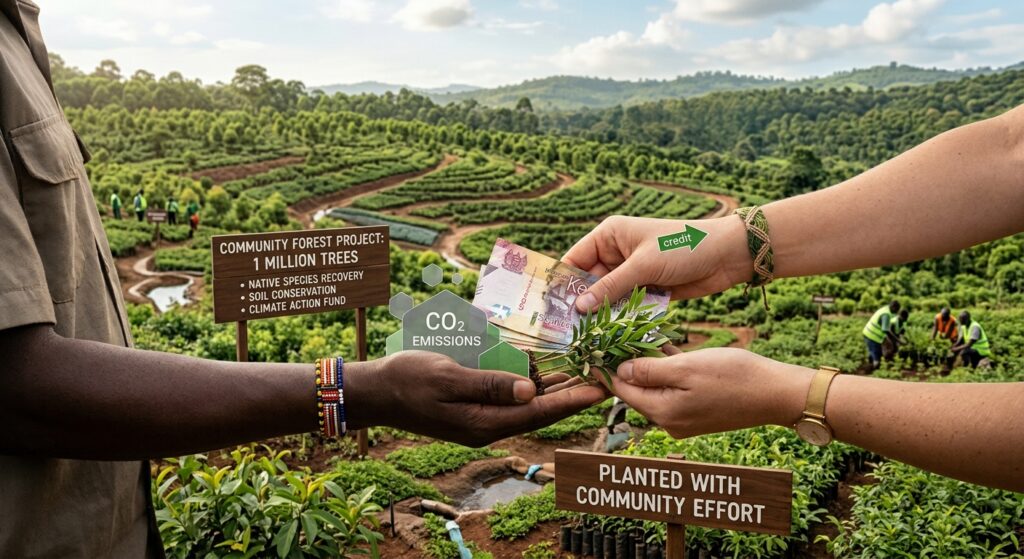
A Representation of carbon trading in action. PHOTO/ MAGNIFIC
A farmer plants a tree on a patch of degraded land. Years later, that tree is still standing, its branches providing shade, its roots holding the soil together and its leaves drawing carbon dioxide from the atmosphere.
But under an emerging model of carbon trading, the tree could eventually do something else: generate income for the farmer and the community protecting it.
Safaricom is exploring a digital marketplace that could connect communities involved in tree growing and other conservation projects with companies seeking carbon credits, allowing proceeds from successful transactions to be paid through M-Pesa.
The proposed platform will be modelled on the Nairobi Securities Exchange (NSE), where carbon credits will be listed and traded through a structured marketplace.
Communities and organisations undertaking conservation projects will be able to generate carbon credits by demonstrating measurable reductions in emissions or the removal of carbon dioxide from the atmosphere.
Companies seeking to offset their carbon footprint will then be able to purchase the credits, with transactions facilitated through the platform.
Safaricom is exploring the integration of M-Pesa to enable payments reach participating communities directly.
The proposal could turn environmental conservation into a source of household income, giving communities an economic reason to protect forests, restore degraded land and grow trees while helping businesses meet their climate commitments.
For a rural household, the potential benefit is not simply the value of a tree standing on its land. It is the possibility that the carbon absorbed and stored by that tree could be measured, converted into a credit, sold to a buyer and translated into money.
That money could help pay school fees, purchase farm inputs, meet medical expenses or support a small business.
At community level, proceeds could finance boreholes, schools, roads and other development projects.
“We are creating an exchange where people can trade on the platform and get paid via M-Pesa. We are trying to use technology to ensure that people can trade,” said Karen Basiye, Safaricom’s head of sustainability, during a media roundtable.
How a tree could translate into income
The opportunity comes with an important qualification: planting a tree does not automatically earn its owner money, according to Basiye.
For a tree-growing initiative to generate carbon credits, the project must demonstrate that it removes or stores measurable amounts of carbon, undergo monitoring and independent verification, and secure buyers for the credits.
This process requires technical expertise, reliable records and financing.
Individual farmers may therefore need to participate through organised community projects, conservation groups or project developers capable of managing the process and negotiating with buyers.
Kenya already has an example of how carbon trading can put money into the hands of communities, although the experience is drawn from the restoration of grazing lands rather than tree planting.
In northern Kenya, pastoralist communities have received carbon credit earnings from a project that rewards improved management of rangelands.
The initiative has channelled proceeds into local development, including education, water infrastructure and community enterprises.
In July 2026, communities in Isiolo, Marsabit, Samburu and Laikipia received Sh655 million through the Northern Kenya Rangelands Carbon Project.
The payment demonstrated how conservation activities can generate financial returns for communities whose livelihoods depend on the natural environment.
But the experience has also exposed the importance of governance.
The project previously faced a suspension of carbon credit issuance amid concerns over transparency and management before reforms enabled it to resume trading.
“We were not able to sell our carbon credits from January, but after thorough investigations and governance reforms, we have resumed trading in the carbon market,” said Andrew Dakhole, chairman of the Northern Kenya Rangelands Carbon Project.
Kenya builds rules for carbon trading
For communities considering tree-based projects, the lesson is that the money must be accompanied by clear agreements on who owns the credits, who pays the costs of developing them and how the proceeds are shared.
Kenya has been putting in place the rules to govern this emerging market.
The Climate Change (Amendment) Act, 2023, established a legal foundation for carbon trading, while the Carbon Markets Regulations, 2024, set out requirements for project approval, community participation and benefit-sharing.
Under the regulations, land-based carbon projects are required to allocate at least 40 per cent of aggregate earnings, after deducting the cost of doing business, towards annual social contributions for communities.
Non-land-based projects are required to contribute at least 25 per cent.
The government has also moved to strengthen oversight.
In February 2026, it launched the Kenya National Carbon Registry to track projects, credits and transactions, helping guard against double counting and improve transparency.
In October, it introduced the Kenya Guide for Strategic Engagement in Carbon Markets 2026, setting out how the country will approach international carbon trading.
The developments reflect a wider global push to use carbon pricing and trading as tools for reducing emissions.
The World Bank’s ‘State and Trends of Carbon Pricing 2026’ report found that carbon pricing mechanisms covered more than 29 per cent of global greenhouse gas emissions, while governments raised more than $107 billion in revenue from carbon pricing instruments in 2025.
Under Article 6 of the Paris Agreement, countries are also developing mechanisms to trade emissions reductions across borders.
However, the market continues to grapple with questions over the credibility of credits, the quality of verification and whether the benefits reach the communities responsible for conservation.
Safaricom’s role in the emerging market
Safaricom is seeking to position itself as an enabler of this market rather than an immediate participant in carbon trading.
The company says it is not planning to buy credits to offset its own emissions in the near term.
“As a business, we are not planning to trade anytime soon. People ask me whether Safaricom intends to buy carbon credits to offset its emissions. No. If we move to the group level, perhaps,” Basiye said.
She added that the company would distinguish between trees planted through community and corporate social responsibility initiatives and those used to offset emissions from its operations.
Projects involving the restoration of water towers and other community conservation activities would not automatically become credits for Safaricom’s own use.
That distinction matters because the value of a carbon market will ultimately be measured not only by the number of credits traded, but also by whether the people protecting the environment receive a fair share of the proceeds, Basiye added in part.
For a farmer, the prospect of earning from a tree will depend on more than putting a seedling in the ground.
“It will depend on whether the project is credible, the buyer is willing to pay, and the money reaches the people who have kept that tree alive.”
If Safaricom’s proposed marketplace secures approval and works as intended, Basiye is hopeful that M-Pesa could help close that final gap, connecting the environmental value of a tree to a payment that a household or community can actually use.