THE HIDDEN TEARS OF HEALERS: THE BURDEN DOCTORS CARRY AFTER LOSING A PATIENT

Dr. Brian Okwomi a Clinical Officer from CKS Dialysis Centre Kimuka at his office. PHOTO BY SYLVIA OPAPA
The hospital corridor is quiet, but inside the emergency room, time seems to stand still, a team of doctors and nurses has spent the last hour fighting to save a patient, monitors beep, instructions are exchanged rapidly, and every available intervention is tried.
Then comes the moment every doctor dreads, ‘TIME OF DEATH’.
For the patient’s family, it is the beginning of unimaginable grief. For the doctor, it marks the end of a battle that could not be won,yet, once the family leaves, another silent struggle begins—one that many people never see.
Doctors are often viewed as emotionally strong professionals who save lives every day, However, behind every white coat is a human being who experiences loss, disappointment, and self-doubt.
Every patient death leaves an emotional mark, regardless of how experienced the doctor may be.
It is devastating! Every loss is different. You never truly get used to losing a patient. Some deaths stay with you for years, especially when the patient was young or when you had cared for them for a long time, DR Brian Okwomi.
Many doctors say they replay the events leading up to a patient’s death, wondering whether there was something they could have done differently, even when they know they followed every medical guideline, they often question their decisions.
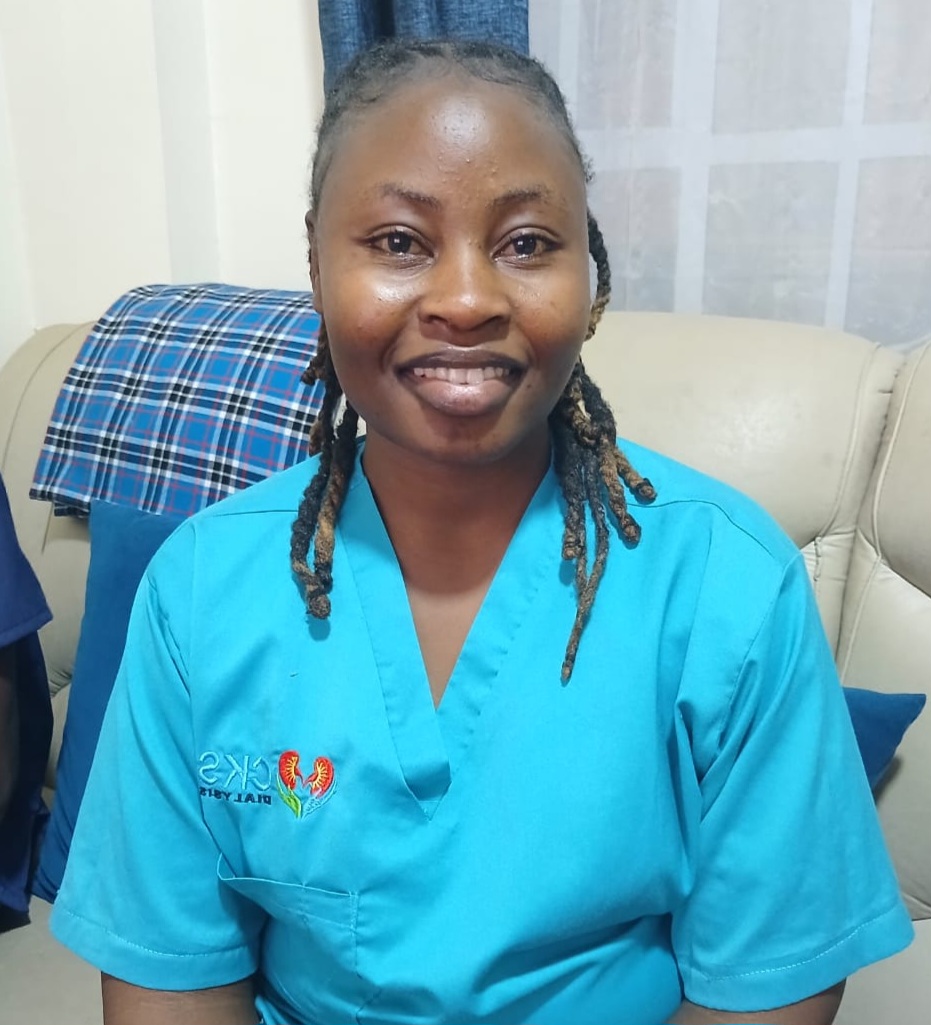
Dr. Nicollet Ongecha during an interview session at CKS Dialysis Centre, Kimuka. PHOTO BY SYLVIA OPAPA
She said that one of the most difficult responsibilities is informing families that their loved one has died.
No medical school can fully prepare you for that conversation. You have to find the right words while knowing that nothing you say will remove their pain. Delivering bad news requires compassion, honesty, and emotional strength, doctors often carry the weight of witnessing families cry, collapse, or struggle to accept the reality of their loss, Dr Nicollet Ongecha.
Despite these experiences, many hospitals provide limited psychological support for healthcare workers, as a result doctors frequently rely on colleagues, close friends, faith, or family members to cope with the emotional burden.
She added that talking to fellow doctors helps because they understand what they are going through, sometimes they simply remind each other that they did everything possible. Balancing compassion with professionalism is another challenge.
Doctors must remain calm and continue caring for other patients, even moments after losing one. There is often little time to grieve before another emergency demands their attention.
Medical experts say that acknowledging these emotions is important, suppressing grief for long periods can contribute to stress, burnout, anxiety, and compassion fatigue, all of which affect both healthcare workers and patient care.
The public often celebrates doctors for the lives they save, but rarely pauses to consider the emotional cost of the lives they cannot.
Behind every final goodbye is a doctor carrying memories that may never completely fade.Perhaps recognizing this hidden burden is the first step toward ensuring that those who care for others also receive the care they need.





Wish every sick person made out of hospitals 😭
The pain that is never realized by many as their profession does not allow them to express their emotions.
A very important and often overlooked conversation. As healthcare workers, we dedicate ourselves to saving lives, but when despite every effort a patient is lost, we also experience grief, self-doubt and emotional exhaustion. Behind every healthcare professional is a human being who feels the weight of every loss.
We need to create healthcare environments where caregivers are also allowed to grieve, seek support and heal. Caring for those who care for others is not a weakness—it is essential for sustainable, compassionate healthcare.
Thank you for highlighting this hidden side of the medical profession.
Interesting piece.
Doctors are warriors , one minute they intaravt with sick patient trying to save them next step they may be gone or they may live 😥
My God help us to heal n heal permanently n start again strong.it is a touching story.God bless all
This is a touching and thought-provoking story. It gives a human perspective to doctors and reminds us that healthcare professionals also experience grief, disappointment and emotional pain when they lose patients. I particularly liked the description of the emergency room because it made the situation feel real. I would, however, like to hear directly from the doctor about how he copes with such experiences.
Respect to all our health care workers. We dont appreciate them enough.
Have always asked myself that courage doctors get to inform the patients family the demise of their loved one.It really feels heavy.May God bless all doctors
This is a very important conversation. A reason why healthcare workers deserve a relationship with God. It is important to remember that we here on earth are just but stewards. The owner , the giver and the taker of life is God. Despite the grief the loss the pain, having done there best to serve a patient, health care workers should never carry the guilt of a lif lost. Hence they should do there part , avoid being negligent seek wisdom and guidance from God and leave the healing restoration or transition of life to the creator
Doctor’s have to grieve,but also stay strong for the next patient.
May all the doctors have compassion on their patients especially in public hospitals where many are left dead, with families contributions to book a bed.
We often focus on the patient and forget that the person trying to save them can also be deeply affected by the loss. A doctor may go home after losing a patient, replaying everything in their mind and wondering what they could have done differently. It is important that we recognise this side of healthcare and give doctors the support they need to cope with these difficult experiences.
Very inspiring story
Doctors too deserve to grieve,…. We are all victims of our own efforts falling apart, I can only imagine how painful it is to have your efforts walking out on you in a casket.
This is a very good piece.
Both patients and doctors /nurses usually have great bond through the encounter,am sure the loss of a patient would be very traumatizing.I feel like an eye opener to remind us the doctors don’t usually get enough grace in circumstances where a patient is lost ,only when the patient survived.This is to remind us they need flowers even trying.
People think healing means no loss but doctors lose too and they still have to walk back in the room and save another life. That is the kind of strength the world is silent about.
Behind every white coat is a human heart. Thank you for fighting even when the outcome hurts. We see you, we appreciate you 🙏
Doctors sacrifice alot to be doctors. I admire their selfless role they play that no school can teach and no salary can compensate.
Wonderful written work. I think the doctors should also embrace workplace counseling/occupational therapy